
Understanding Purgatory

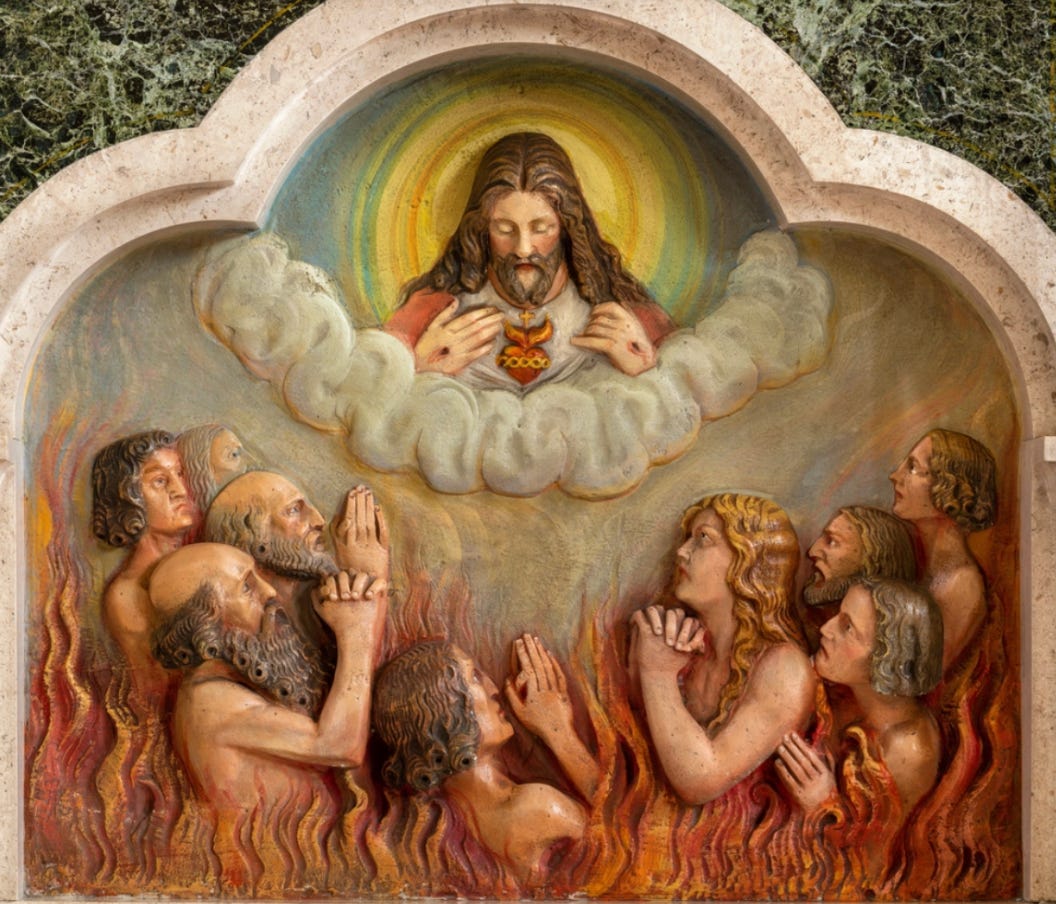
This post will be about purgatory, which is in fact real, and not a made up doctrine by the Catholic Church. Obviously as followers of Christ, our goal is to stay faithful and obedient to the end so that we may join God in Heaven with Our Lord granting us so on judgement day. Unfortunately, some will choose to reject our Lord and Savior, or sort of accept Him, but refuse to repent of their sins. Though purgatory is not an intermediary place for some to go to rather than simply Heaven or Hell, it is a place that might be required for some before they go to Heaven. A great quote by C.S. Lewis on purgatory was this: “Our souls demand Purgatory. Would it not break the heart if God said to us, ‘It is true, my son, that your breath smells and your rags drip with mud and slime, but we are charitable here and no one will upbraid you with these things, nor draw away from you; enter into joy?”
So what is the Biblical backing for purgatory? Though the word for purgatory is not specifically noted in the Bible (neither is the word Trinity or Incarnation or Eucharist for what it’s worth, although like purgatory- these concepts are understood and demonstrated throughout these times). Purgatory doesn’t necessarily need to be in the Bible- since Sola Scriptura is false, but it does have hints at it biblically that can aid our view of it. Read Revelation 5:8 which says: “When He had taken the book, the four living creatures and the twenty-four elders fell down before the Lamb, each one holding a harp and golden bowls full of incense, which are the prayers of the saints.” Read 1 Timothy 2:1-4: “First of all, then, I urge that supplications, prayers, intercessions, and thanksgivings be made for all people, for kings and all who are in high positions, that we may lead a peaceful and quiet life, godly and dignified in every way. This is good, and it is pleasing in the sight of God our Savior, who desires zall people to be saved and ato come to bthe knowledge of the truth.” Why would souls in Heaven need our prayers? They don’t, nor do those in hell, since they are separated from God forever. But those in purgatory do. Look at John 5:25: “Very truly I tell you, a time is coming and has now come when the dead will hear the voice of the Son of God and those who hear will live.”
Reading from Matthew 27:51-53, it says: “The earth quaked, rocks were split, tombs were opened, and the bodies of many saints who had fallen asleep were raised. And coming forth from their tombs after his resurrection, they entered the holy city and appeared to many.” Revelation 21:27 says: “Nothing unclean will enter the presence of God in heaven.” But since we all fall short of the glory of God and sin, how can we enter the Kingdom of God? Yes, Christ is what saves us and who forgives sin along with the Father, but some have to enter a period of purification before they go to Heaven. Those who are truly saved by Christ go to heaven, while those who reject Him and continue sinning are damned for eternity, unfortunately. But for those who say: “Why would purgatory exist if what Christ did on the cross takes away our sins,” realize that only occurs if WE truly repent of our sins. Those who have lived good lives through Christ, but have done faults they have not fully repented of their sins when they die will ultimately still have heaven or hell WILL be the result from God on judgment day- but purgatory serves as a temporary period to remove some of the sins of those that have not been truly repented during their time on earth, but who are going to Heaven anyways.
Written in the intertestamental period, we can read from 2 Maccabees 12:41-46, or for those Protestant brothers and sisters who have this book missing in their Bible thanks to Martin Luther- search it online or open a Catholic Bible, and read from it: “Then they all blessed the just judgment of the Lord, who had discovered the things that were hidden And so betaking themselves to prayers, they besought him, that the sin which had been committed might be forgotten. But the most valiant Judas exhorted the people to keep themselves from sin, forasmuch as they saw before their eyes what had happened, because of the sins of those that were slain. And making a gathering, he sent twelve thousand drachms of silver to Jerusalem for sacrifice to be offered for the sins of the dead, thinking well and religiously concerning the resurrection (For if he had not hoped that they that were slain should rise again, it would have seemed superfluous and vain to pray for the dead And because he considered that they who had fallen asleep with godliness, had great grace laid up for them. It is therefore a holy and wholesome thought to pray for the dead, that they may be loosed from sins.“ Luther even believed in Purgatory, for a time, before changing, saying: “I have never yet denied that there is a purgatory, and I still hold that there is, as I have many times written and confessed, though I have no way of proving it incontrovertibly, either by Scripture or reason decision… It is enough for us to know that they [sols in purgatory] are in great and intolerable pain, and crave our help.”
St Augustine also has some useful quotes on purgatory:
“If, then, works of mercy are celebrated for the sake of those who are being remembered, who would hesitate to recommend them, on whose behalf prayers to God are not offered in vain? It is not at all to be doubted that such prayers are of profit to the dead; but for such of them as lived before their death in a way that makes it possible for these things to be useful to them after death” (ibid., 172:2).
“Temporal punishments are suffered by some in this life only, by some after death, by some both here and hereafter, but all of them before that last and strictest judgment. But not all who suffer temporal punishments after death will come to eternal punishments, which are to follow after that judgment” (The City of God 21:13 [A.D. 419]).
Purgatory is real, and we pray for those going through that process as described in 1 Corinthians 3:15: “If any man's work burn, he shall suffer loss; but he himself shall be saved, yet so as by fire,” we receive the grace of God for those that haven’t fully repented but honored Christ and will join Him soonly. Catechism 1030-1031 says:
“The Church gives the name Purgatory to this final purification of the elect, which is entirely different from the punishment of the damned. The Church formulated her doctrine of faith on Purgatory especially at the Councils of Florence and Trent. The tradition of the Church, by reference to certain texts of Scripture, speaks of a cleansing fire:
As for certain lesser faults, we must believe that, before the Final Judgment, there is a purifying fire. He who is truth says that whoever utters blasphemy against the Holy Spirit will be pardoned neither in this age nor in the age to come. From this sentence we understand that certain offenses can be forgiven in this age, but certain others in the age to come.”
1472 To understand this doctrine and practice of the Church, it is necessary to understand that sin has a double consequence. Grave sin deprives us of communion with God and therefore makes us incapable of eternal life, the privation of which is called the "eternal punishment" of sin. On the other hand every sin, even venial, entails an unhealthy attachment to creatures, which must be purified either here on earth, or after death in the state called Purgatory. This purification frees one from what is called the "temporal punishment" of sin. These two punishments must not be conceived of as a kind of vengeance inflicted by God from without, but as following from the very nature of sin. A conversion which proceeds from a fervent charity can attain the complete purification of the sinner in such a way that no punishment would remain.”
Sources:
https://aleteia.org/2018/08/02/c-s-lewis-tells-you-why-you-should-like-purgatory/amp/
http://www.scborromeo.org/ccc/para/1031.htm